
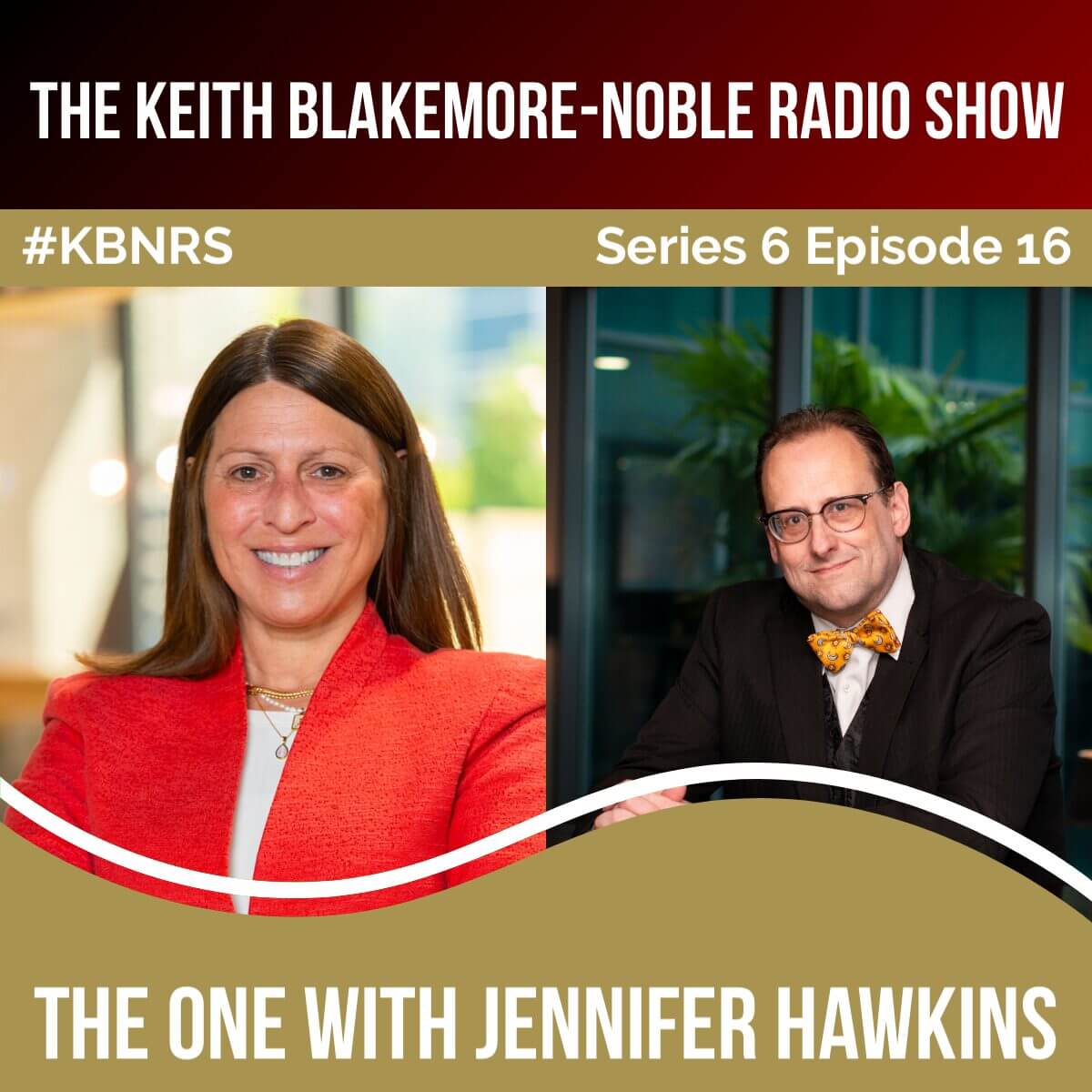

About This Episode
I sit down with Jennifer Hawkins, founder of Launched Performance, a leadership advisory firm dedicated to helping mid-level leaders step confidently into executive roles as organisations prepare for a wave of retirements among senior leaders.
Jennifer shares her extraordinary journey from rising quickly through five different industries, to transforming a struggling Sylvan Learning Centre into a top performer through two recessions, to later leading blood banking operations across seven states, all while managing her son’s battle with leukaemia from a hospital room. She opens up about her passion for legacy, leadership, and resilience, and explains how lessons from her own personal adversity have shaped her approach to empowering tomorrow’s business leaders.
We talk about her admiration for Eleanor Roosevelt’s approach to leadership and boundaries, as well as practical strategies for multiplying leaders and building collaborative, future-ready teams. Jennifer brings valuable insights for anyone interested in thriving through change. Tune in for an inspiring story of perseverance, innovation, and the drive to make a difference, both at home and within organisations facing transformational times.
Key Theme
- Leadership succession and legacy planning
- Navigating adversity in personal and professional life
- Multiplying leaders through mentoring and collaboration
- Turning around failing organisations during recessions
- Empowering mid-level managers for executive roles
- Keeping effective boundaries while leading
- Breaking down silos for team success
- Adapting organisations for future workforce needs
- Lessons learned from overcoming family health crises
- Role models: Eleanor Roosevelt and leadership empathy
About My Guest
Jennifer Hawkins is the founder of Launched Performance, a leadership advisory firm dedicated to helping executives become enterprise-level strategists and prepare organisations for seamless succession.
Rapidly rising through five different industries, Jennifer made her mark by transforming the worst-performing Sylvan Learning Centre into a top 20% performer during two recessions, and later led blood banking operations across seven states, all while managing her son’s leukaemia from a hospital room.
Drawing on her remarkable resilience and strategic insight, Jennifer now empowers mid-level leaders to confidently step into executive roles, helping them build the strategy and legacy needed for long-term organisational success.
You can find out more about Jennifer via:
www.linkedin.com/in/jenniferhawkins/
LaunchedPerformance.com/
jennifer@launchedperformance.com
“Action, and action now”.
– Franklin D. Roosevelt

If You Prefer Video
Transcript
Click to Expand or Collapse
Keith Blakemore-Noble [00:00:14]:
You’re listening to the Keith Blakemore-Noble radio Show. Interesting chats with interesting people about interesting things and no adverts. Hey. Hello, hello, hello. Welcome back. Welcome back to another episode. I have a fantastic guest with me.
Keith Blakemore-Noble [00:00:38]:
This episode, as always, have fantastic guests. Why would I have one who’s not My guest this time is a lady called Jennifer Hawkins. Now, Jennifer is the founder of Launched Performance, which is a leadership advisory firm which helps executives to build enterprise level strategists and to prepare for succession before the wave of retirements hits. She rose quickly through five industries, turning the worst performing Sylvan Learning Centre into a top 20% performer through two recessions and later led blood banking operations across seven states whilst managing her son’s leukaemia from a hospital room. Today she equips mid level leaders to step into executive roles with the strategy, confidence and resilience that it takes to carry a legacy forwards. That is my guest today. Let’s bring her in. Hello, Jennifer, how are you?
Jennifer Hawkins [00:01:44]:
I am great, thank you. I’m excited to be here.
Keith Blakemore-Noble [00:01:49]:
I’m really pleased to have you with us. Thank you so much for taking time out of your day to join us. We’ve heard your bio. Who’s Jennifer? Who is the lady behind it all?
Jennifer Hawkins [00:02:03]:
Gosh, you know, I’m first and foremost, I’m a mom and a wife, right. My family, I always believe in family first. And I think you, you know, you kind of touched a little on the leukaemia and that sort of thing and if you can imagine, that really rocked our world living through that. And so personally, you would know me now as we talk all the time, like hopefully I’m knocking on wood. There will never be a bad day like those days. Right. And so just keeping that in mind, and I’m someone who believes in legacy, you know, I think you touched on that too. It’s really important to me that I’m setting a legacy for my children as well as these organisations who are about to go through a major change.
Jennifer Hawkins [00:02:53]:
With the wave of retirements happening at the baby boomer and Gen Xer level, the majority of executives fit into that window and we really haven’t, as you know, an enterprise, as a country and even worldwide, been developing the middle layer of leaders in the way that we need to so that they can take that, not only take the baton, but it’s really the workforce of tomorrow. And the companies of tomorrow are going to need to look different because our millennials and younger see it differently. And therefore what got you Here won’t get you there. And so how are you preparing for that and what are you doing for that? What is the legacy that you’re leaving behind and who are you picking to help carry the torch forward in a way that works for tomorrow? That’s really me in a nutshell.
Keith Blakemore-Noble [00:03:49]:
Fantastic. And I know we’ve got a couple of really, really key things that we’re going to explore today. Just before we do that, though, just before we started recording this, obviously we were having a chat and you mentioned, yeah, you mentioned a person who would be always be your top choice for, you know, that age old question. If you could have tea, sit down and have tea with anyone, past or present, who would it be? You’ve got a brilliant person who is always your immediate top choice. Who is that? Share it with us. Who would be your ideal person to sit down and have a chat with over a nice cup of tea?
Jennifer Hawkins [00:04:33]:
Eleanor Roosevelt. I think that so many times we hear about the woman behind the man. I do not see her as the woman behind the man. I see her as front and centre. You know, a country and even a world. You know, I think people look to her for the brilliant way that she saw the world. She was so ahead of her time and the way that she helped not only within the White House, but also with women. Right.
Jennifer Hawkins [00:05:05]:
With the politics and how we can navigate through these extreme adversity that our countries in the world were experiencing. And I just find her fascinating because so many times we don’t see leaders that know how to do that, to really pull a country together, to really pull teams together and people together. And so for me, she’s. And she’s absolutely a role model of empathy and understanding and looking beyond to, to see how can we pivot, what can we do to manage through such a crisis and thrive on the other side. And she kept her boundaries. Right. And I loved that about her. And yet people adored her.
Jennifer Hawkins [00:06:01]:
Right. So she’s also proof that you can have effective boundaries and still make a huge difference in the world and really build collaboration and break down silos. And she just was. She’s just such a role model for me.
Keith Blakemore-Noble [00:06:19]:
Absolutely. You mentioned that she was able to keep her boundaries and still achieve all these things. I wonder if perhaps part of the reason that she was able to achieve all of these and the collaborations, everything, was precisely because she kept those boundaries which enabled her to work so successfully with so many different people.
Jennifer Hawkins [00:06:40]:
Yeah, she’s just incredible.
Keith Blakemore-Noble [00:06:43]:
Incredible. Absolutely. Now, you mentioned that she and her husband, the President, did a lot of work to help a lot of people through adversity, particularly as the country was going through a very bad time at that point. And I know adversity is something that you’re no stranger to, particularly a couple of. Couple of areas of your life which jump out, which we’re going to look at. Let’s take a look at the first one. You. Yeah, I mean, you took a really poorly performing outfit and turned it into a top 20% performer through two recessions.
Keith Blakemore-Noble [00:07:25]:
Tell us a bit about, tell us a bit about that. How you first got involved and how you managed to successfully navigate not one, but. But two recessions. Yeah.
Jennifer Hawkins [00:07:36]:
And, you know, I’m super young, so I came up through the ranks in insurance. But in that time frame, my brother had been in a major car accident and he had struggled in school and unfortunately had gotten involved in drugs and just all these different things. And the car accident left him pretty debilitated. So we never got to step out of that or turn that around. And so for me, there was a hunger there to make a difference where we couldn’t with my brother. My brother was six years younger than me. And so here I am, I’ve got this great career I’m scaling in insurance, all this great stuff. And I have this hunger for helping kids who are like my brother.
Jennifer Hawkins [00:08:25]:
And through my research and investigation, I realised that education is a vehicle to, you know, when kids feel great in school and they do well in school, they typically don’t fall into those traps and patterns. And so I sought out, you know, looking into that. And in the same time, Sylvan Learning centre in another area had contacted me. And so that began this journey. And I ended up buying a sylvan at only 29 years old on my credit card. There was a big negotiation there. They wanted much more than much, much, much. Probably like it was more than my house.
Jennifer Hawkins [00:09:08]:
And I got it down to a credit card. And that was really. Because they had opened a month post 9, 11. And so they were literally the worst performing centre in the country. So over a thousand centres were out there and they weren’t making any money. And again, that was a lot of what was happening. Right. It was a really tough recession at the time.
Jennifer Hawkins [00:09:36]:
And I walked in there and said, look, I don’t just want to work for you. They had put out a posting and I was like, I want to own this. So left insurance, put it on my credit card, and Scott scaled to the top 20% within 18 months. And that was crazy during that time. But I learned in My insurance experience and through all the training, the beautiful training that I had received in corporate that way with those amazing organisations was you multiply leaders, you lean into your team, you find that zone of genius. And so I was able to do that with the people who were working at the Sylvan at the time. And we built these programs and I got out into the community, something I had never had to do before in my work, and just learned a lot during that time frame. And then came along the 2008 recession.
Jennifer Hawkins [00:10:35]:
So here we scaled, we did all this great stuff, and bam, here we go again. And so that was the mortgage crisis, and actually, I think that one was almost worse, at least for our area, and again, just continued to thrive. And when I finally sold it, you know, I sold it for a significantly higher amount even than they had asked me for in the first place. So. And. And that was shortly thereafter. So all those lessons I carried with me, and yeah, that really made a difference.
Keith Blakemore-Noble [00:11:14]:
So what would you say are some of the biggest lessons that you got from this and which helped you to really scale it up?
Jennifer Hawkins [00:11:22]:
Well, that was when I first started to learn how to lean into my staff. So what was happening is we were getting really creative with the programs and the resources we already had. And so I think. So, first of all, putting our heads together, I lean into them as subject matter experts for what their zone of genius is, for what their expertise is. And I trust them explicitly because I’ve already built their leadership skills and I’m also well aware of where their strengths are. And so putting my group together and saying, okay, guys, we’re not going to weather this storm if nothing is. If nothing is different, we’re not going to get through these recessions. What can we do? And we started to do some really creative things.
Jennifer Hawkins [00:12:13]:
So we had these programs, we were chiseling them down to really streamline them, make them efficient. Right? Because there was a lot of fluff and things maybe that they’re nice to have, but they didn’t have to happen. Right. So that was the first thing we realised. And that allowed us to get families in for a lower price point, which made it more affordable for them during a difficult time. And then the other thing is, we went and received accreditation, just like a school. Our programs qualified for that. So we sought state accreditation so that we could actually teach like a school.
Jennifer Hawkins [00:12:52]:
And then I did. So during the day, our facility was empty unless we were testing kids. And it was like, this is silly. We have all this, you know, real estate here, not being Used what can we do and, and accomplish the goal of filling in these skill gaps so these kids, you know, aren’t struggling forever. Right. And that became really popular for us. So instead of the after school, what I had was a hunger from parents of yeah, you be the school. And that was fantastic.
Jennifer Hawkins [00:13:30]:
And that really carried us through that 2008 recession. And we also tapped into the government contracts of no Child Left behind where we were actually going to different schools, setting up pop ups in the libraries, that sort of thing. So going into all these communities in our large area territory and setting up shop, bringing our programs with us and then very efficiently really just down and dirty. What do kids need to have and teaching them? And that was getting paid through school resources, school dollars, and so all of that collectively. But again, that’s taking a look at what you already have and the genius around you and your team leaning into all of that, getting creative collectively and figuring out how you’re not only gonna survive, but thrive. And that’s what we did.
Keith Blakemore-Noble [00:14:30]:
Got it, Got it. So I mean, for me, the, the key things that jump out there were trimming, trimming away all the stuff that isn’t absolutely necessary for it. So what you’ve got is nice, tightly honed and it’s, it’s, it’s the core stuff. Get rid of all the fluff that distracts and, and so on, and look at what you have, look at what your underutilised resources are and look at what your potential customers need and see how you can, you can match the two so that you better serve the customers whilst using more of the stuff that you’ve got sat around doing nothing. Basically.
Jennifer Hawkins [00:15:06]:
Yeah, for sure. Those were key, key takeaways.
Keith Blakemore-Noble [00:15:11]:
Love that, love that. And you, you then very successfully sold that business. Having grown it and then grown it again through a second recession, you then very successfully sold it for a lot more than they’d originally wanted you to buy it for, let alone a lot more than you originally invested.
Jennifer Hawkins [00:15:30]:
Yeah, it was serendipitous that that happened. The ironic thing is I wasn’t looking to sell it at the time. So it was funny how that story came about and how I landed at the blood centre. That really is for most people a wild part of my journey. And for us too, you know, we’ll never quite understand. So if you believe in, you know, whether you believe in fate or God, whatever it is that you, you know, subscribe to. Yeah, we, we had, I had received two phone calls. One so I would help a company in consulting with them.
Jennifer Hawkins [00:16:11]:
So they could lift their company, which I wasn’t in the business of that, but went ahead and did that. And then two, I was. Because I was a top franchisee, I used to get phone calls that the corporation would send potential franchisors to talk to me. And through that conversation, he wanted to buy mine, too. And my husband was like, we weren’t for sale. And my husband said, this is. There’s something to this. We need to pay attention to this.
Jennifer Hawkins [00:16:45]:
So I think we need to sell. And. And then I landed at the blood bank, and six months later, my son ends up with a blood cancer that the blood bank helped. Actually, they were the ones who figured it out, and that’s how we got the diagnosis. So crazy, right? Crazy journey.
Keith Blakemore-Noble [00:17:06]:
Wow. So how did you say we ended up at the blood bank? How did that happen? Talk us through how that came about.
Jennifer Hawkins [00:17:14]:
Well, it’s so funny, because if you knew me, you would know I’m not a science girl. I mean. I mean, typically, I learned to be, but I didn’t start that way. And so when my husband brought that, like, hey, I think we need to do this. So I agreed to sell it to this franchisor, and I agreed to consult with him for a year to help him get on his feet. But in the meantime, I’m lost. I’m like, that was my identity. Like, I loved what I was doing.
Jennifer Hawkins [00:17:48]:
It was all about this mission work. Like, I was helping kids that were like, my brother. Like, what am I going to. I don’t know what I’m going to do with myself now. And I. Someone I needed to work. Like, that’s just who I. You know, I needed that.
Jennifer Hawkins [00:18:02]:
That. That outlet and to be doing something for me. And so I was lost. And a girlfriend of mine said, hey, did you hear that the blood centre is hiring? And I was like, are you nuts? Do you know me? I’m not science. And she was like, no, no, no, no, no. This is a lot of the same kind of skill sets that you used while at Sylvan. You have to get into the community, right? You’re really selling a mission. Your last mission was kids, you know, and helping them.
Jennifer Hawkins [00:18:35]:
Now this is about patients. It’s. It’s really up your alley because it’s the donor recruitment, so getting donors in the door to donate blood. She’s like, no, like, you’re not working. You know, you’re not. You’re not the one who’s doing the needle stuff, stick, or any of that. And I was like, okay. So I.
Jennifer Hawkins [00:18:55]:
Very skeptical I went ahead and reached out, applied, and in that interview, when they started asking me why I left Sylvan, I started bawling. So I have no experience for blood banking, Right? They have other candidates that have plenty of blood banking experience from across the country in leadership. And I’m bawling, and I’m like, I don’t even know why I sold my Sylvan. It’s now I can’t even get it back, right? And I’m like, my life. And they hired me anyway. Can you believe that? And. And they had turned over their whole department, this whole donor recruitment department. So we ended up.
Jennifer Hawkins [00:19:36]:
So I got the job, and I hired a whole team, and together we learned blood banking, and I multiplied leaders, just like I did at Soviet, just like I had been doing in my insurance world. This wasn’t new to me, and. But blood banking was. And then my son is sick, and I don’t know what’s happening, why he’s sick. We can’t figure it out. We’re on our third set of Z packs because that’s what the doctors keep doing. And I reach out to our medical director. I sent him an email, and I’m like, I know I’m being one of those moms.
Jennifer Hawkins [00:20:14]:
I’ve taken him to the doctor three times now. But he. He’s really sick. And I describe what’s happening, and my desk phone. I swear I felt like I had just hit the send button. My desk phone lights up. It’s Dr. Randlett, our medical director, who’s a pathologist, and his whole world is blood cancers.
Jennifer Hawkins [00:20:36]:
And he said, Jennifer. He started drilling me with questions, and I felt like that lasted forever. It was so surreal. Like, I was almost watching myself. It was crazy. And at the end of that, he said, Jennifer, Ryan has leukaemia, and we need to get you to Children’s Hospital. He has to go to the hospital today. And we entered that hospital, and he didn’t.
Jennifer Hawkins [00:21:01]:
And that was June. That was mid June. He didn’t come out until the holidays. And we were living. I lived in that hospital. So here I am, brand new. And thank goodness I had amazing leaders who allowed for that, and I had amazing team of leaders that I had built as well. And.
Jennifer Hawkins [00:21:23]:
And we didn’t just weather that. But for two and a half years, he relapsed. Right then we had to do a bone marrow transplant. We had to. We had to travel for that. And this is all prior to the pandemic. This wasn’t right. Like, we were not set up at the blood centre.
Jennifer Hawkins [00:21:39]:
For this. So again, just that lessons of leaning into your team, leaning into your leaders, leaning into your community. I had mentors who helped me through and navigate his leukaemia side too. Plus that medical director. I told you about all of those people. It was an incredible time.
Keith Blakemore-Noble [00:21:59]:
And how is your son now?
Jennifer Hawkins [00:22:01]:
He’s doing great. He’s 26. You know, he graduated. I’m so proud of him. He. If I can just have a mama moment here. So he was young when that happened and he wasn’t able to start high school. So he had tutors, as you can imagine, through that time frame.
Jennifer Hawkins [00:22:21]:
And he graduated high school at 17 on time. He took every zero hour, every after school during the summer. And if you can imagine my son, because he had graph versus host and he was sick all the time with gut issues and skin. He would. I would drop him off about 5:50 in the morning at school. It was still dark out and he would vomit. I swear he vomited every day in their bushes. I feel so bad for that school.
Jennifer Hawkins [00:22:51]:
Whoever had to clean that up. And the teachers would see that and they knew just how hard he was working. And he would enter that school. School and he would work his tail off. And he did that through that whole time. He graduated with a 4.0 seventh in his class. And then he went. He was accepted into the University of Washington.
Jennifer Hawkins [00:23:14]:
Not an easy school to get into. And. And then would graduate with a 3.89. But then, let’s not forget, a pandemic happened in that. And he was again, isolated. And that was very triggering to be isolated again like that and just so proud of him. And today he’s. He’s just doing well.
Jennifer Hawkins [00:23:36]:
He’ll always have medical issues, kids with cancer, that’s just kind of their life. But. But he’s. He’s doing well. And I’m so grateful. Right. It was a hell of a journey.
Keith Blakemore-Noble [00:23:48]:
Yeah. No, I imagine. And good, good. Well done. Well done to him for pushing through and for all the things that he’s achieved so far and will no doubt continue to achieve.
Jennifer Hawkins [00:24:01]:
Yeah.
Keith Blakemore-Noble [00:24:02]:
I want to just finish up with one final question for you. One thing to explore. You’ve mentioned it a few times that you multiplied leaders. Can you just tell us a little bit about what does that mean? What does it look like? And how would one go about starting to do that?
Jennifer Hawkins [00:24:23]:
Yeah. You know what my favourite is to do? I like to look around, especially with the people who don’t realise their own zone of genius or they’ve never had the confidence. Right. To step into the Limelight, or to say, hey, I, I’m an expert in this, or really show that off. And so when I enter into a new arena or I get someone right into our team, I spend time really building relationships and getting to know them and watching, you know, kind of where not only their metrics are, but how they interact, what just really picking up on what are they excellent at, and then talking to them about that. Look, you know, I’ve been watching you. You’re excellent at xyz. I’m so impressed.
Jennifer Hawkins [00:25:13]:
You know, and we have folks on the team struggling in xyz. And so I do this with everyone on my team and everyone ends up with a carve out of what their zone of genius is. And we really display that for the whole team. They become the go to the subject matter expert in xyz. And so then I’ll say to them, great, I’m going to have you mentor these folks over here struggling. And by the way, because you struggle with this, they’re going to mentor you in their zones of genius in their abc, you know, zone. And what you do is you’re lifting all the boats at the same time and you’re creating teamwork and you’re breaking down the competitive barriers that people often feel, right? And I don’t just do that there, but I do that cross departmentally too. So people not in my department, how can we reach out? How can we go observe them? What can we learn about maybe how our department is adversely affecting their department? Can we get into a group together and solve that? I did a lot of that too, where I had a meeting with all the subject matter experts of the department.
Jennifer Hawkins [00:26:32]:
And a lot of times that could be the department head or it might not be, they would come together and so solve, especially with blood banking, because so many things in order to ensure that there’s no break in that supply, right? There’s so many different departments and bringing them together and making sure all our obstacles are figured out ahead so that we’re always putting blood on the shelf so that nothing stops us from accomplishing that. And so that’s really breaking down silos and building leaders because they learn how to do that with each other. They learn how to communicate effectively, they learn how to, you know, be curious, right? I didn’t show up with all the answers. I got curious. And, you know, and so we did all of that. And so that really is how I did that. And I have a long list of, you know, leaders, executive leaders, senior leaders behind me who that I feel really excited about, you know, that are thriving today in those high level roles and that’s really with my signature programs, you know, the shift method and my cohorts, what I’m doing today. These are the skills and systems and frameworks that I’m continuously working on.
Jennifer Hawkins [00:27:55]:
So the executives are building companies for tomorrow.
Keith Blakemore-Noble [00:28:01]:
Got it, Got it. I absolutely, I love that. I love that. I love the way you get them all to collaborate so as you say, get rid of the competitive nature, turn into a collaborative nature. So they’re not fighting each other to see who’s best, they’re helping each other to become the best.
Jennifer Hawkins [00:28:18]:
Yeah, for sure.
Keith Blakemore-Noble [00:28:20]:
I love that. Hopefully, dear viewer, dear Lister, hopefully you’ve been enjoying this too. If you have, please remember, give us a like a comment, a share subscribe on your favourite platform. Remember, we’re available on Apple Podcasts, Amazon music, audible, Spotify, YouTube, everywhere. Basically give us a review, share it with your friends far and wide. Jennifer, thank you so much for taking time out to share this with us today. I’ve loved the journey that you’ve taken us on. Love the points that have come out from it as well.
Keith Blakemore-Noble [00:28:54]:
So thank you so much. I know there are going to be people who are going to want to find out more, maybe even get in touch. What’s the best way for them to do that.
Jennifer Hawkins [00:29:03]:
Yes, My website is launchedperformance.com and you can find me on LinkedIn. I’m very active on LinkedIn. Each week I’m putting out a lot of content with tips and techniques. So please follow me there. And yeah, and jenniferaunchperformance.com if you want to get ahold of me Direct. But launchperformance.com is my website and that will always get you to me.
Keith Blakemore-Noble [00:29:30]:
Brilliant. So launchedperformance.com connect with Jennifer, find out more about her. Obviously all her contact details, LinkedIn, the email, the whole lot. They’re all in the show notes as always. Go to keithplatemorenoble.com show and look for the one with Jennifer Hawkins and you’ll find all the contact details there. Or just go to launchedperformance.com Jennifer, thank you so much for taking time out. I hope you’ve enjoyed it as much as I have.
Jennifer Hawkins [00:30:07]:
I had a blast. Thank you so much for having me.
Keith Blakemore-Noble [00:30:10]:
My absolute pleasure. We started the episode with a quote from. Oh no we didn’t. We started the episode with your favourite person to sit down and have a cup of tea with, which was Eleanor Roosevelt. We’re finishing with your favourite quote which comes from Franklin D. Roosevelt. And Jennifer’s favourite quote is “Action, and action Now.” You’ve been listening to the Keith Blakemore Noble Radio Show.
Keith Blakemore-Noble [00:30:56]:
To find out more, Visit KeithBlakemoreNoble.com


